
2025 | Sponsored Project
Unifying the gallery experience at the Georgia Aquarium
Role: UI/UX Designer
Timeline: August - December 2025
Stakeholder: Georgia Aquarium
Team: Josalyn Chow, Tanya Punater, Natasha Valluri

500+ Species, 9 Galleries, 3,000,000+ Visitors
Background:
The Georgia Aquarium is a non-profit in Atlanta that houses over 500 aquatic and terrestrial species across nine galleries and receives 3M+ visitors per year.
Their mission centers on education, conservation, and ethical animal care through immersive experiences like the Touch Pool, Dolphin Show, and digital exhibits.
Project Goal:
Implement a digital, gamified experience that remains accessible, inclusive, and suitable for all guests through potential scavenger hunts, badge earning, and species discovery
The aim is to provide a cohesive, personalized experience that helps first-time visitors navigate the aquarium’s scale and variety without feeling overwhelmed.
How might we create a cohesive, interactive experience that considers

Education

Conservation

Gamification

Accessibility

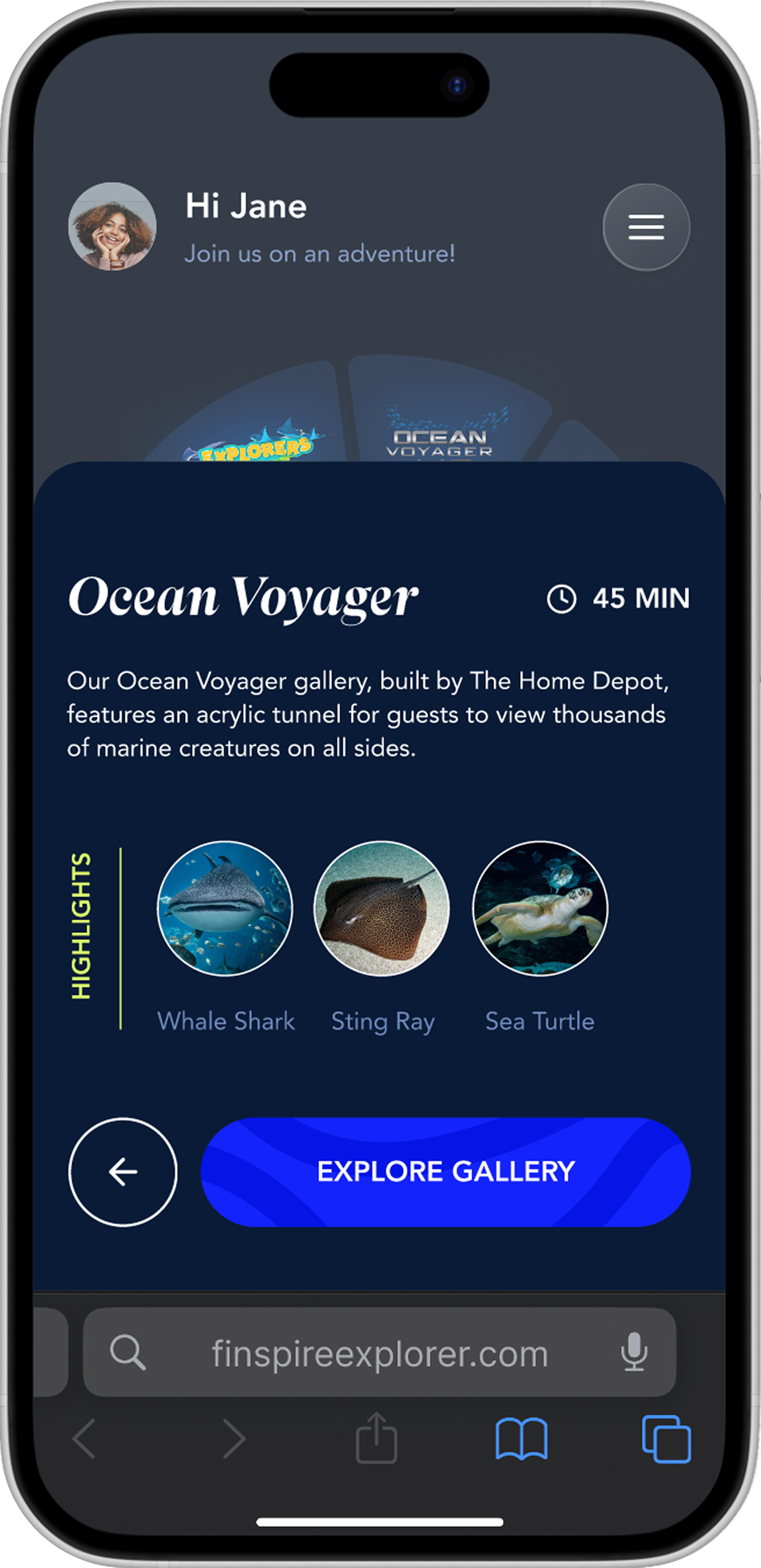
The Solution: Finspire Explorer Webapp
A companion webapp that turns gallery and species discovery into an adventure through a customizable scavenger search
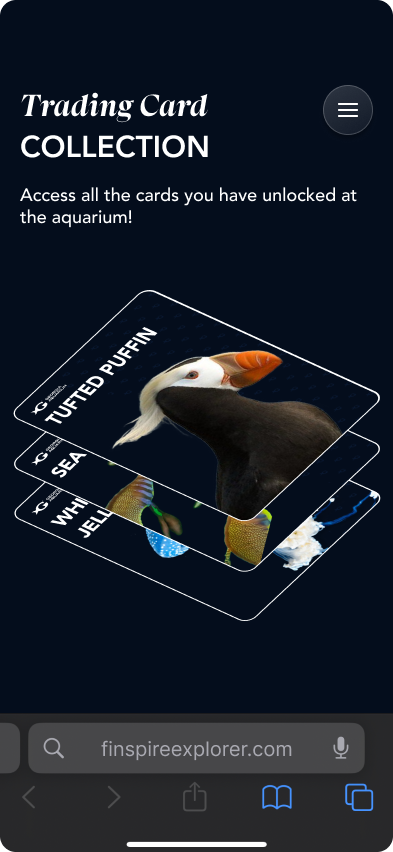
With 500+ species to discover, it’s easy for guests to feel overwhelmed and thus, overlook some animals. Finspire Explorer turns that challenge into an opportunity by spotlighting one “mystery species” per gallery, inviting visitors to identify it through a series of illustrated clues. A correct guess unlocks a digital trading card which is part souvenir and part conservation tool.
Designed for all ages and levels of marine knowledge, this scavenger-style game brings lesser-known or endangered animals into the spotlight while encouraging guests to look closer, engage with their surroundings, and track their exploration progress.
Onboarding & Product Tour
Introduce guests to the companion webapp’s features and functions
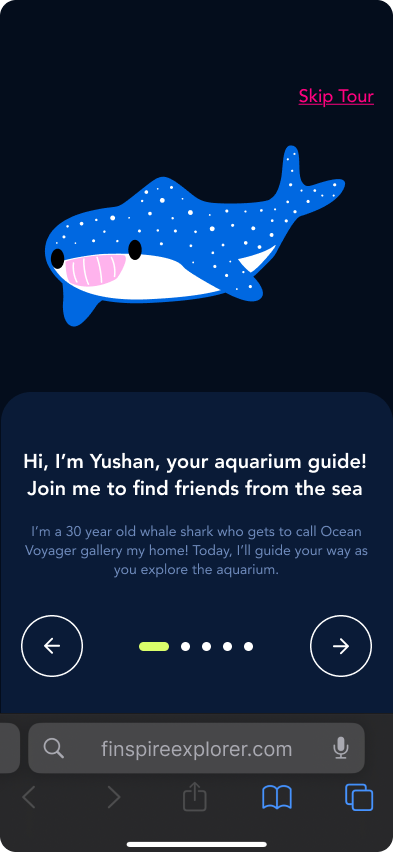
Onboarding introduces users to the webapp by offering flexible entry options. The aquarium’s whale shark, Yushan, walks users through key features, like the aquarium map, scavenger search, answer submission, and trading cards!
Aquarium Map & Exploration Levels
Select a gallery and difficulty level to begin the scavenger search
* Scavenger “Hunt” doesn’t sound very conservation friendly :(
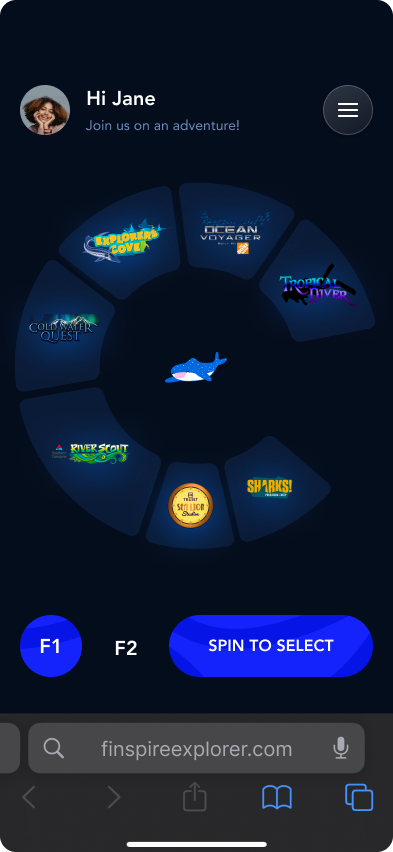
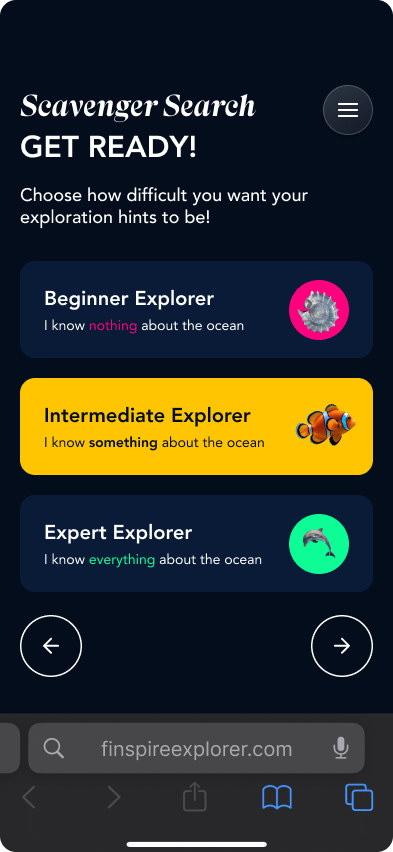
Users land on a map of the aquarium, where they can browse gallery details or let Yushan randomly select a starting point. After selecting a gallery, users can choose an exploration level and receive a overview of the scavenger search.
Scavenger Search & Submission
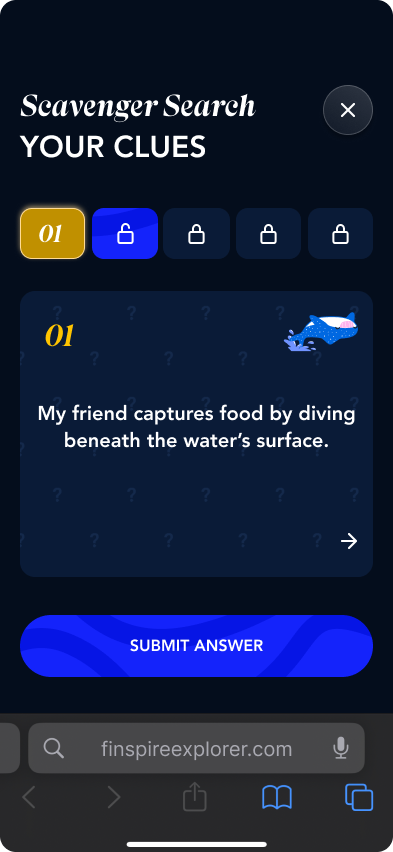
Use 5 illustrated clues to identify the mystery species and submit your guess
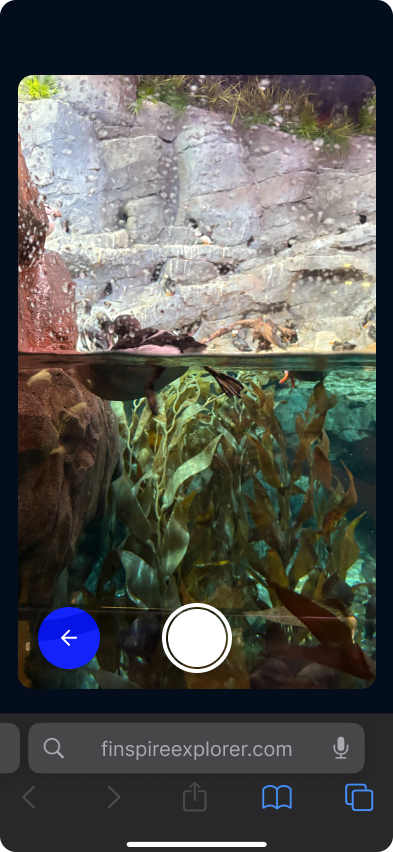
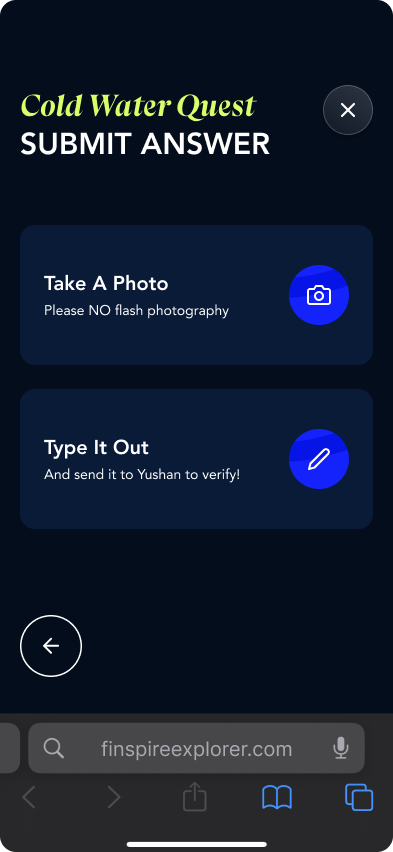
Users unlock five progressively detailed clues to identify a mystery animal in the gallery they have chosen. Users can submit an answer by text or photo, and receive immediate feedback, with flexible options to retry, save progress, or exit.
App Menu & Digital Card
Earn a digital trading card and invite users to join your gallery adventures
After identifying the correct animal users receive a digital trading card with species fun facts, audio, live cams, and donation links. All cards are saved in a wallet, while settings allow users to invite fellow visitors to join in the fun!
Curious about the design process? Keep scrolling to learn more about:

Research

Ideation

User Feedback x 3

Synthesis

Wireframes
RESEARCH
Getting to know the Stakeholders & Users

What are the industry standards?
Field Observations & Comp Analysis: Visited the Georgia Aquarium and Zoo Atlanta to observe how their signage, messaging, and interactive prototypes influence the visitor experience. Compared other cultural institutions (MET Museum, Monterey Bay Aquarium, etc.) to understand their approaches to gamification
Who exactly are the 2M+ users?
Visitor Survey | 111+ Responses: Collected survey data to identify visitor demographics, visiting frequency, preparedness, and general experiences with the animal galleries. We conducted 3 separate tabling sessions at the aquarium to cultivate a large, diverse dataset that is more representative of the visitors.

How do users engage & interact?
Contextual Inquiry | 12 Participants: To understand how visitors behave in the aquarium, we observed their interactions with the aquarium galleries, digital components, & signage. Gained reasoning and insight into their actions by asking follow-up questions.

How do users feel, think, & recall?
SemiStructured Interviews | 12 Participants: Gathered detailed, in-depth recollections from the CI participants after their visit. Asked open-ended questions to get rich stories and elaboration into the motivations behind their choices and decision-making during their visit.

What do users enjoy or dislike?
Intercept Interview | 20 Participants: Collected in-the-moment insights from guests about their reflections and takeaways from their ongoing experience. Had the ability to probe about one select topic and go in depth with the user. Conversed with elderly visitors, employees, and family groups, all of whom we not have had access to otherwise.
SYNTHESIS
Identifying patterns with Affinity Mapping
01
User struggles with finding meaning out of their aquarium experience.
“[I want to know]…there are things I can be doing to improve the well being of the ones out there”
02
User is confused about galleries and what species they contain.
“There were a lot of options, just with the names, I couldn’t tell what is in each of them...”
03
User does not enjoy viewing digital screens at galleries.
“I was not a fan of having screens in any of the places… especially ones that that were competing with the viewing window for visual attention”
04
Users were heavily drawn to galleries with unique, immersive experiences.
“I feel like I just stare at it all day… It's like the classic view you associate with an aquarium as well, with all the children at the glass windows. So I really like that.”
05
User is eager to collect and share knowledge and memories from the aquarium.
“These projections are instagram story-worthy”
“I want to purchase the medallion of the dolphin now”
SYNTHESIS
Addressing shared user needs with design
What are the user’s specific needs?
01: The user needs to be able to easily identify contents and themes of every gallery in the aquarium.
02: The user needs to have an interaction with the fish to facilitate a better connection.
03: The user needs the aquarium to match the larger-than-life, grand expectations visitors have
04: The user needs to be educated about the conservation efforts being carried out by the aquarium team
05: The user needs to experience positive, hopeful environments during their visit.
06: The user needs to have a way to commemorate / share their visit
07: The user needs to have flexibility in the planning of their aquarium visit.

How can I use design to meet them?
DI-01: The design must include prominent, and easy to understand indicators about the galleries’ contents (such as signage, etc).
DI-02: The design must incorporate opportunities for interactions at the aquarium, be it tactile, visual or auditory.
DI-03: The design must use interactive elements that allow visitors to feel surrounded by the ocean environment
DI-04: The design must provide persistent displays of educational gallery information that tie into real-life conservation activities.
DI-05: The design must allow users to experience galleries as narrative journeys with tangible examples of conservation
DI-06: The design must allow users to collect and share their experiences, digitally/physically, about interactions and memories
DI-07: The design must be personalizable/customizable to user input, providing multiple options for navigation.
IDEATION
Concepts to enhance the aquarium visit
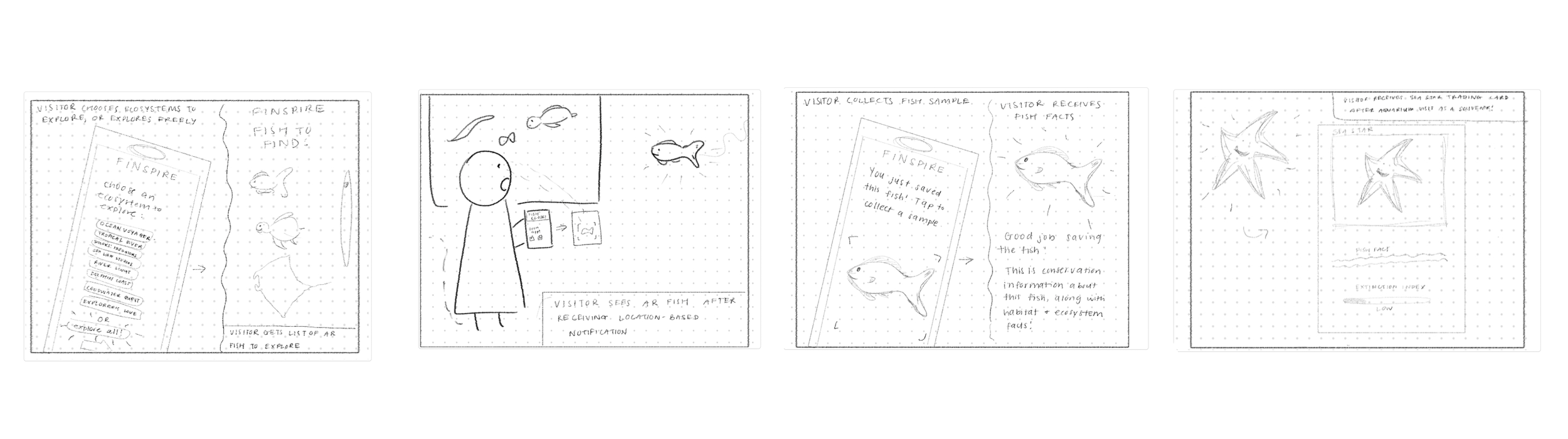
AR Animal Rescue Roleplay
Concept Description
AR experience for participants to assume the role of a marine biologist and go on conservation missions to “save” different species. When they complete the challenge, they win a prize!
Design Considerations
Clues, puzzles, and hints foster an interactive educational experience & promotes conservation (DI-04). Digital animal cards serve as shareable memorabilia (DI-06).
Accessibility Concerns
May hinder the experience for visitors who don’t want to use devices when viewing the galleries. Need to include audio/haptic feedback to make scavenger hunt accessible for low-vision users.

Animal Life Journey Experience
Concept Description
A narrative journey that uses projectors, projection mapping, and signage to highlight the life story of specific species. Users can locate the species and capture memories in real time!
Design Considerations
Can bring attention to overlooked species at the aquarium (DI 03). The sketch follows a user as they track the life journey of a turtle. This narrative storytelling may build empathy (DI 05).
Accessibility Concerns
Audio feedback will be lucrative for visitors who want to take a self-guided experience. A concern was the visibility of the wall QR code, due to the lighting and “dark spots”
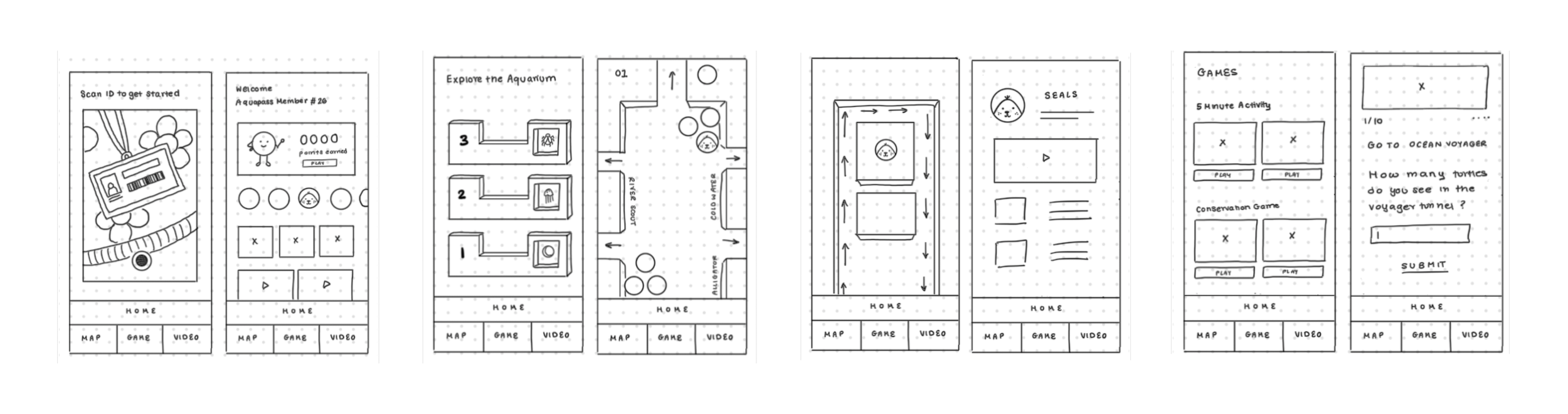
K-6 Gamified Marine Education
Concept Description
An interactive educational app that helps K–6 children explore ocean life through a 3D aquarium map, games, and animal facts. It extends learning with videos and lesson plans.
Design Considerations
The 3D map improves visitor navigation by allowing users to visualize the galleries (DI 01).In order to complete the games, users must engage with signage and employees (DI 02).
Accessibility Concerns
3D map does not indicate accessible navigation routes. The games do not provide translation for ESL users, audio translation for visually impaired users, or flexible phrasing.
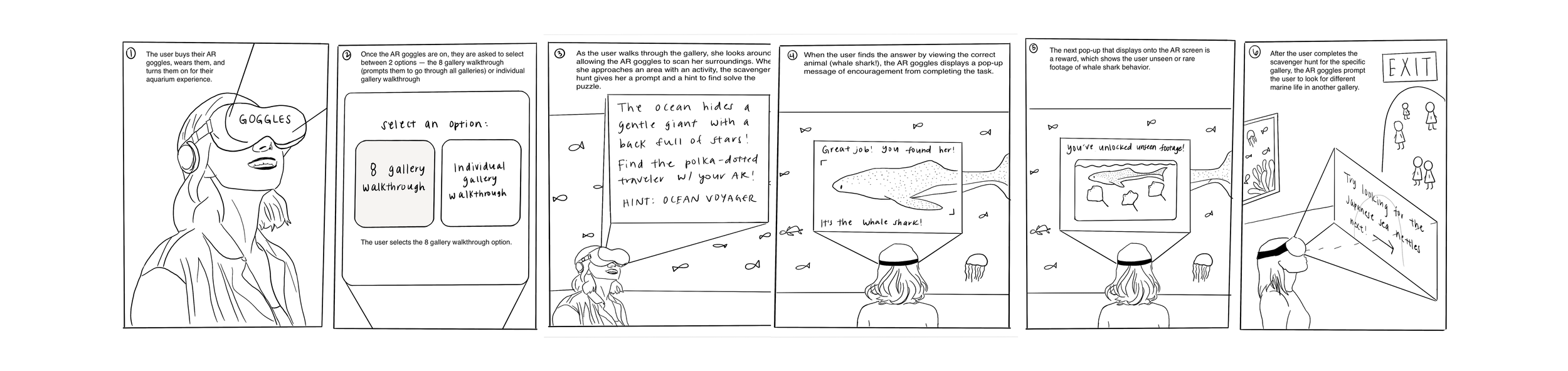
AR Scavenger Hunt
Concept Description
AR headset that display a scavenger hunt of the galleries. As the user walks through the gallery, they will be asked to search for certain marine life based on the clues or puzzles provided.
Design Considerations
Users can scan their environment, engage with the fish, and navigate (DI 02). Users have a choice between the 8 gallery walkthrough or the individual walkthrough (DI 07).
Accessibility Concerns
May be difficult for visitors with glasses or visually impaired individuals to wear and interact with. Could create motion sickness for visitors with existing vestibular concerns.
USER TESTING 01
Do users actually need any of this?
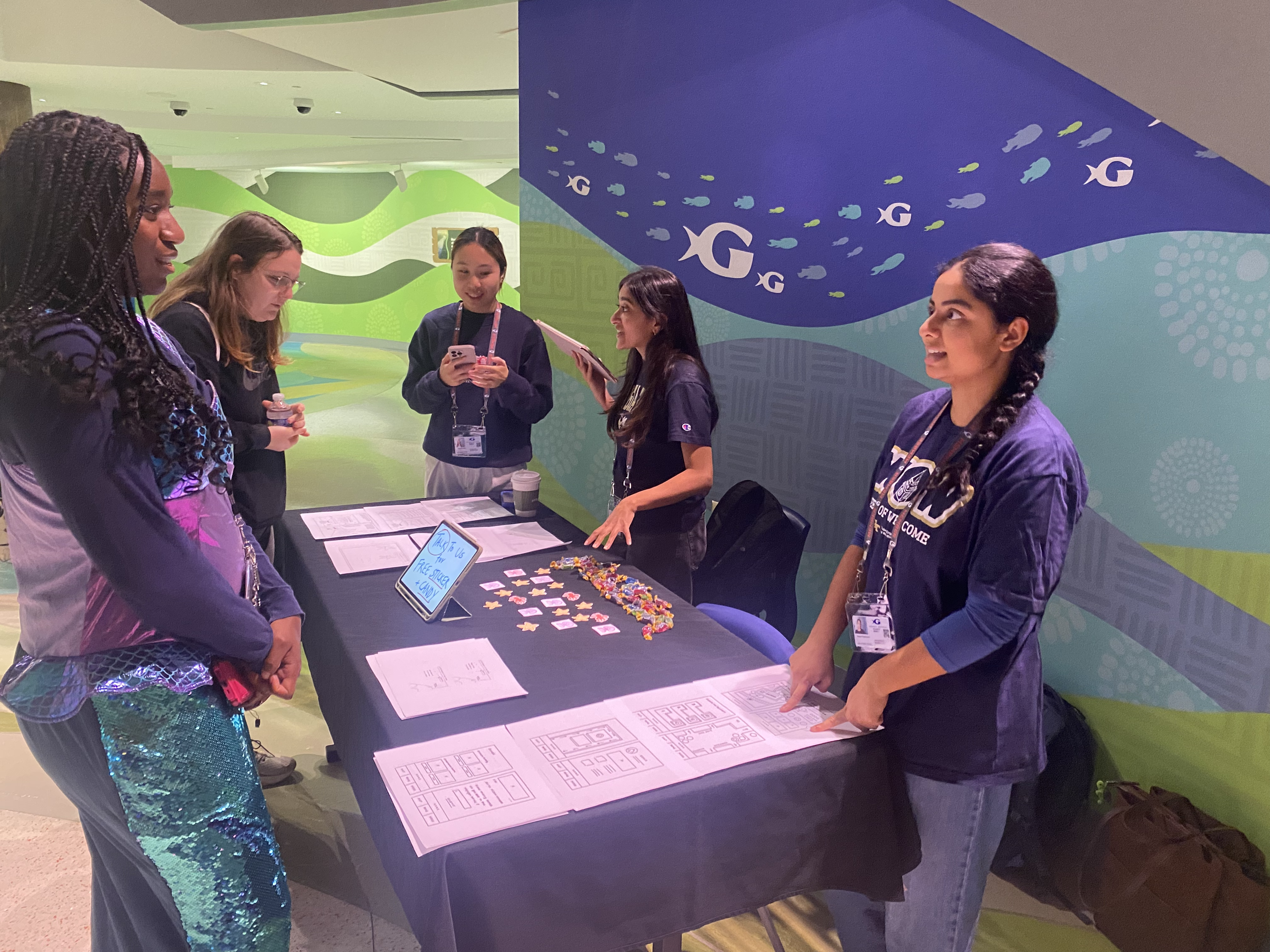
Turns out, yes they do! Here’s what we found:
We conducted 2 feedback sessions at the aquarium by pitching the ideas to families, couples, and the aquarium staff. They provided us with their first impressions, initial thoughts, and what they would do differently to make the concept valuable.
User Feedback & Bugs:
AR can be confusing, so we must provide alternative interaction options for users
Users are invested in learning about conservation at their own pace, so we need to support independent exploration
Gamification was very popular, so we need to ensure it is simple and visually engaging for all user age groups
User want to learn about conservation efforts, so this messaging must be reinforced through visuals and rewards
WIREFRAMING
Turning user insights into a design direction
Final Concept Description
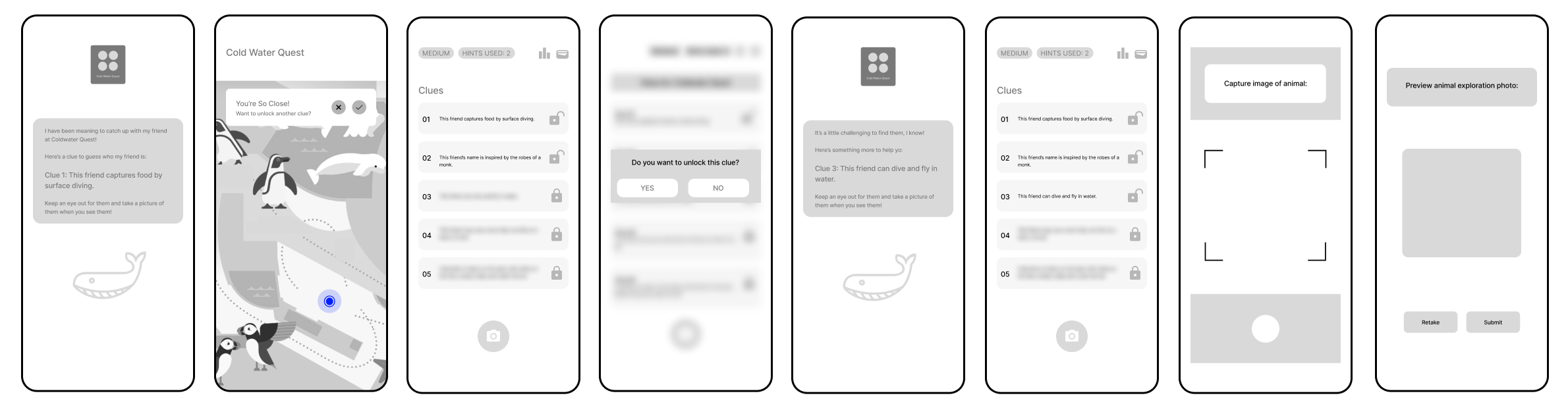
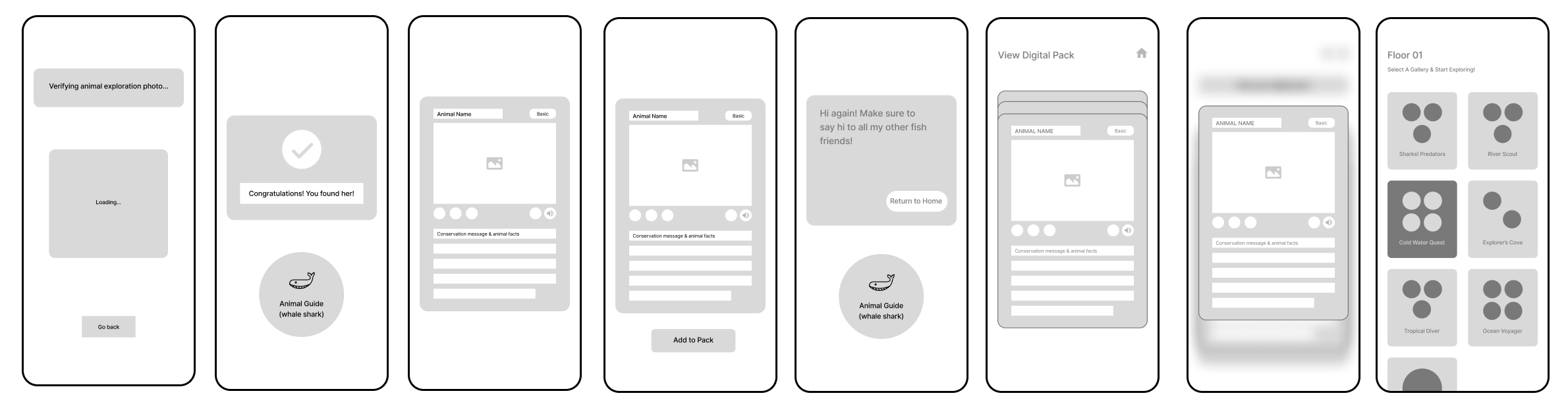
Our finalized concept merges our 1st and 2nd sketch concepts.This concept is a webapp with monthly scavenger search spotlighting one animal per gallery, revealing their story through interactive clues, hints, and puzzles.
Design Considerations: DI 01-07
The flexible scavenger search encourages exploration and empathy. Gamified features like difficulty levels, an interactive map, and collectible cards keep the experience engaging while reinforcing conservation messages.
Accessibility Ideas
We hoped to create a text-to-speech feature to read out information, a feature that plays real animal sounds, and make the written content easily understandable for all visitor age groups and languages.
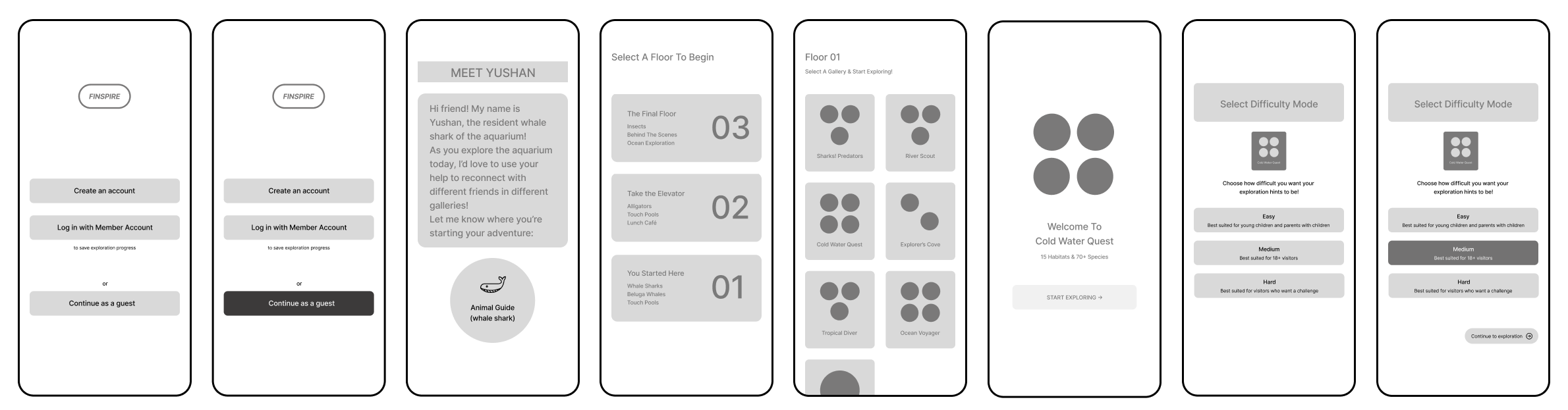
USER TESTING 02
No such thing as toooo many user insights
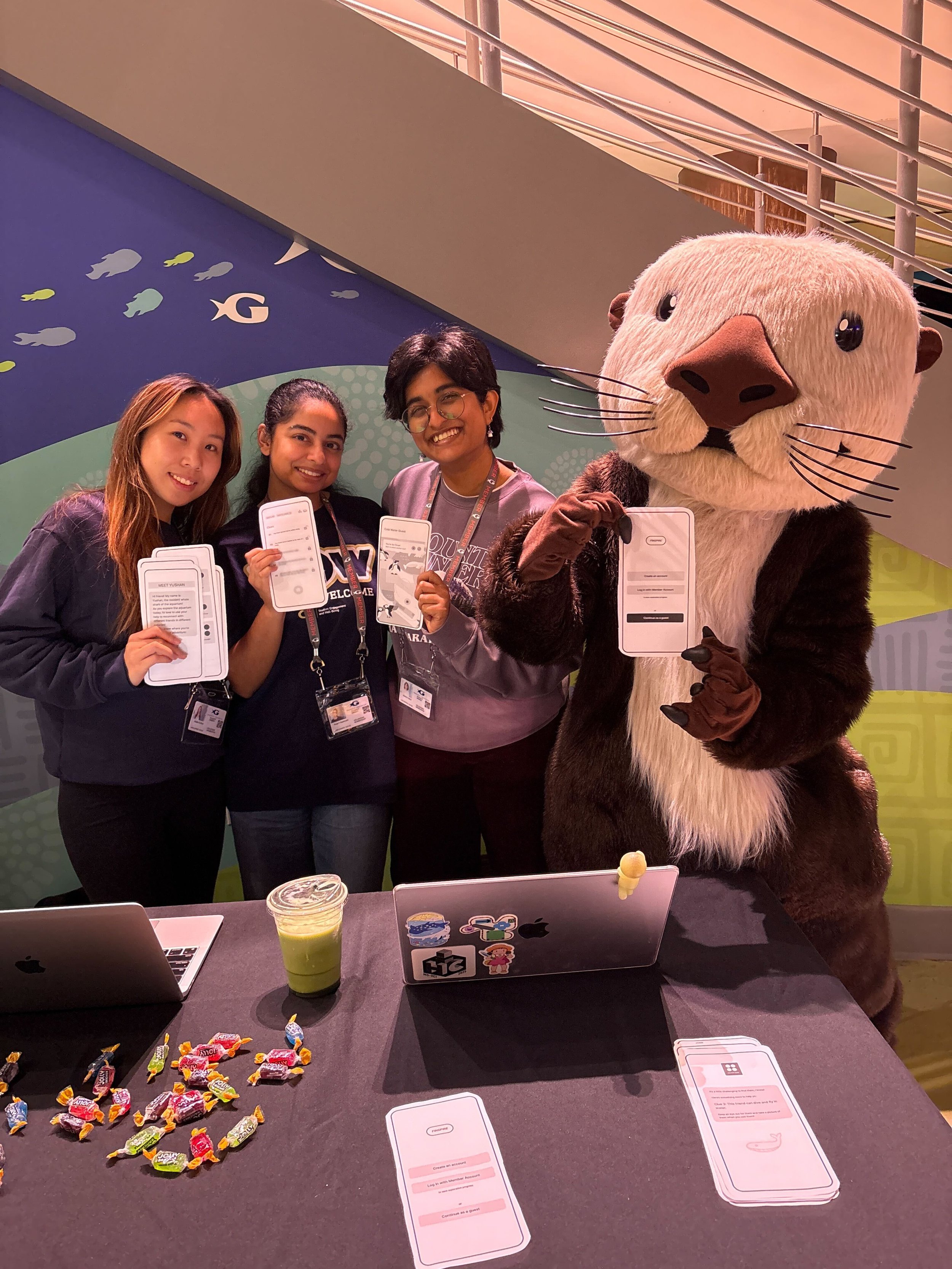
More tabling! Here’s what we found:
Our team conducted think-aloud sessions by prompting each user(s) to complete a task they were given frame by frame. Question categories included first impressions, element or feature specific, and general questions. Here’s what our users need us to do:
Intuitive Navigation: Align page flow with the aquarium’s layout, clearly listing galleries by floor and featured animals or habitats.
Clear UX Writing: Use accurate icons and instructions to clarify interactions.
Learning Through Rewards: Encourage education with digital and physical collectible cards, including rare blind packs.
Familiar Mental Models: Leverage familiar icons and mechanics to reduce learning effort.
Stronger Onboarding: Explain how the platform works, its goals, rewards upfront.
Clear Value & Expectations: Communicate features and benefits clearly
WIREFRAMING
Iterating towards Finspire Explorer
How might we create an experience that considers education, gamification, conservation, and access?
Education
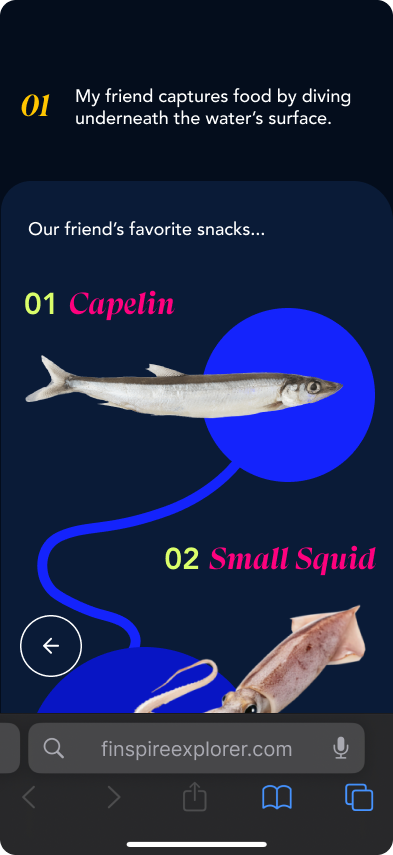
Clues: The clues used to find the Mystery Species are educational facts that use real-life imagery to makes learning more intuitive and contextual. The clues become progressively detailed as the user unlocks more.
Digital Trading Card: After the user correctly identifies the Mystery Species, they earn a digital trading card with more fun facts about that animal. This reinforces their long-term understanding of the animal.
Gamification
Aquarium Map: “Spin to Select,” to randomize gallery selection
Webapp Mascot: Yushan, the webapp mascot, drives engagement through storytelling. His emotional states humanize the experience.
Scavenger Search: Encourages guests to look closer at the tanks and engage with their surroundings (signage, employees, etc.)
Conservation
Mystery Species: The scavenger-style game brings lesser-known or endangered animals into the spotlight.
Digital Trading Card: The trading cards include facts about the mystery animal’s conservation status and how users can donate to help.
Accessibility
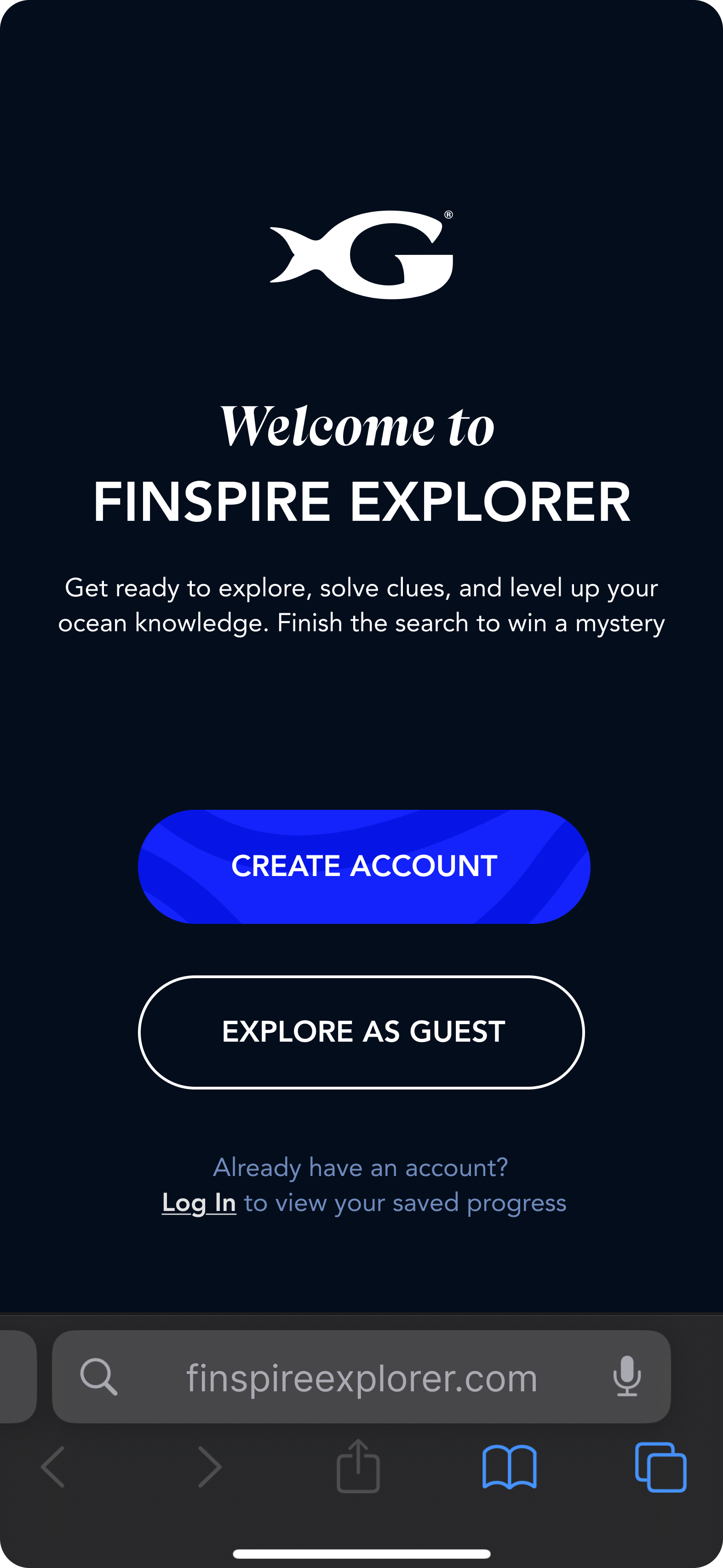
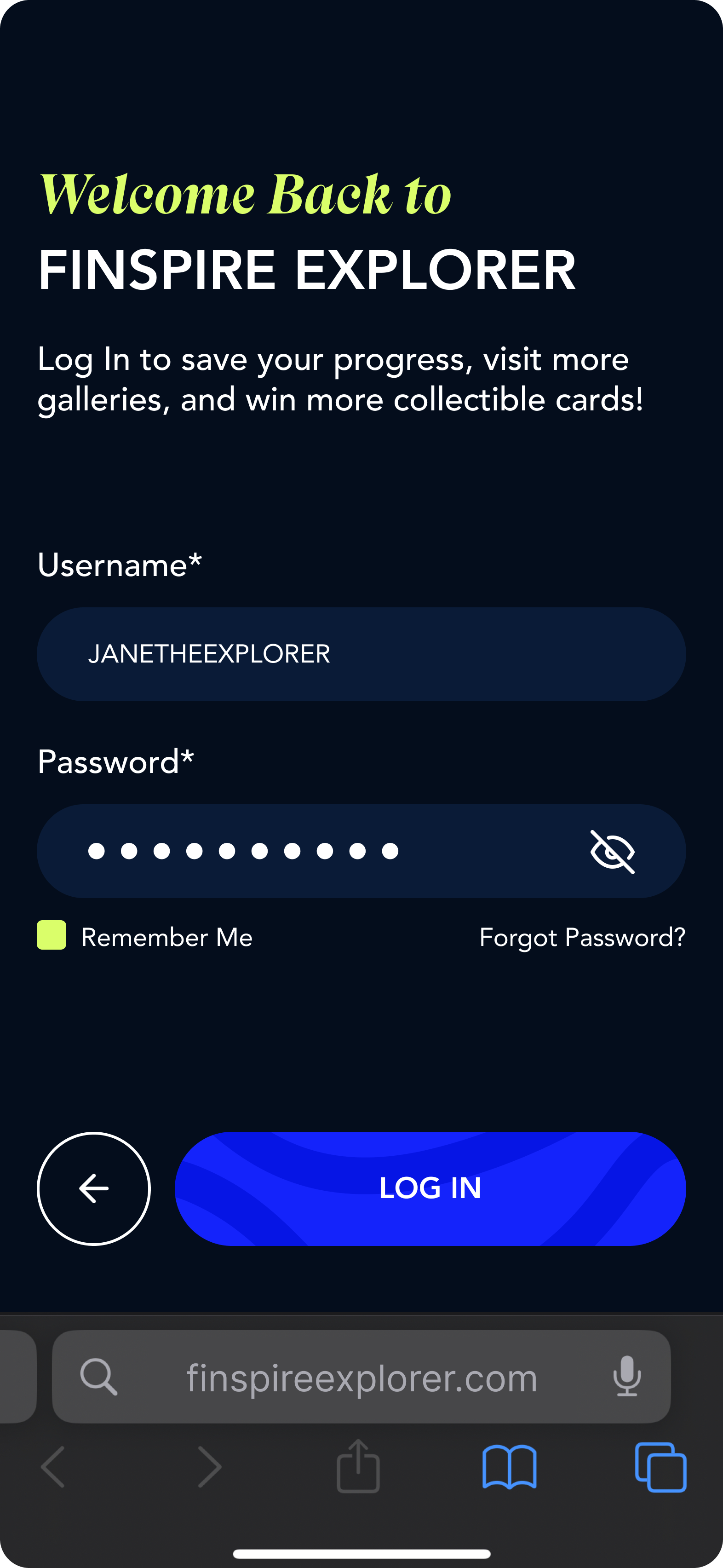
Guest Access: Creating an account for a temporary experience can be tedious, so allowing visitors to have guest access provides options
UI Design: Dark mode to avoid distracting users by keeping their focus on the physical habitats and large buttons for children and older visitors.
USER TESTING 03
Validating with Users & Industry Experts
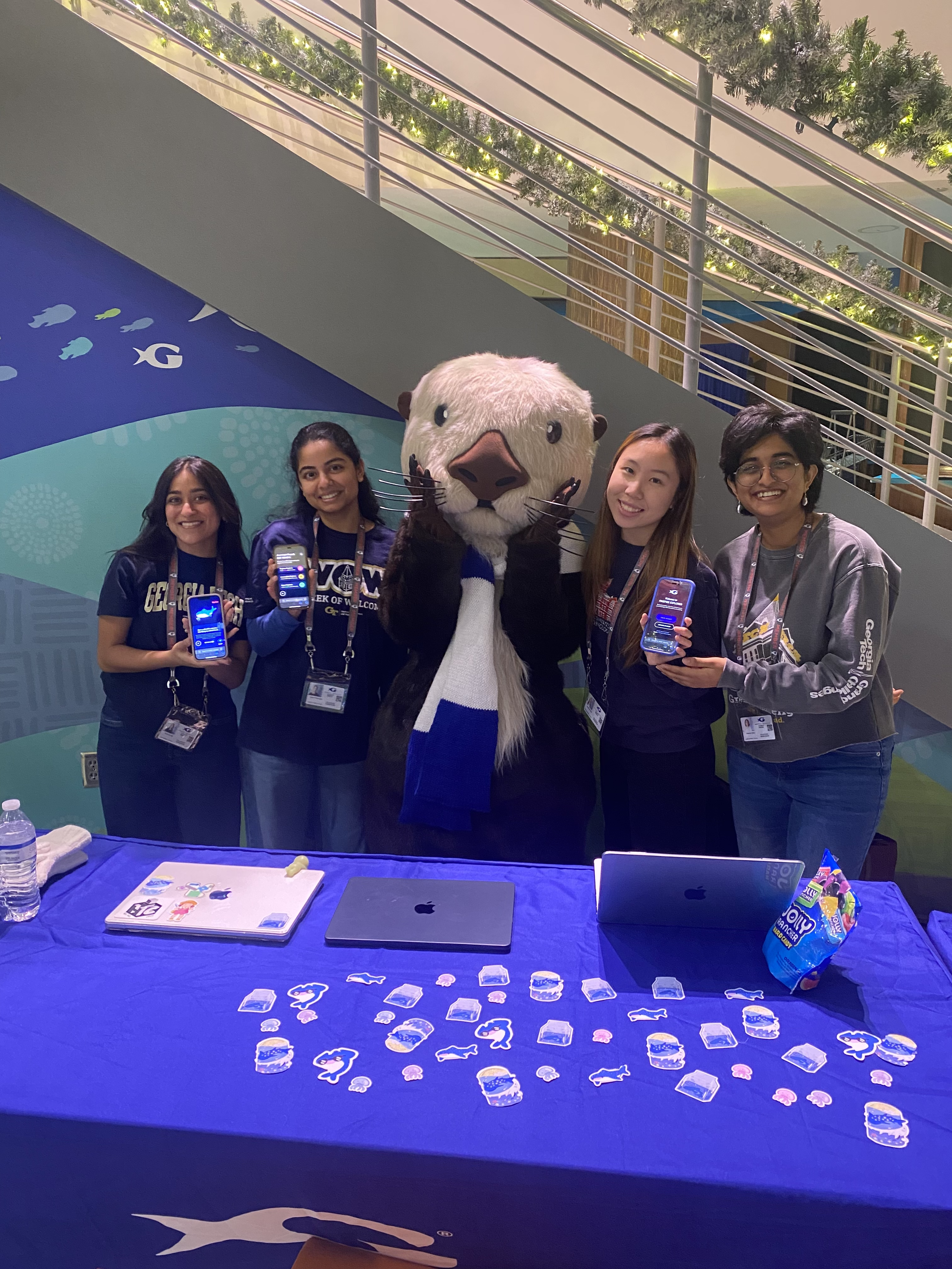
We aim to implement their suggestions:
Clarify Player Levels: While the game uses Beginner, Intermediate, and Expert labels, each level should have clearer descriptions to set accurate expectations.
Visual Progress Cues: Visual indicators now signal when the next clue is ready to be unlocked, improving clarity and flow.
This update was prioritized and implemented in the high-fidelity designs.
Post-Play Account Creation: Guest should be prompted to create an account after completing a game, helping retain progress and increase return visits.
Conservation & Donations: To better support Finspire’s conservation mission, donation options should be made more visible within core flows.
Improve Accessibility: Gallery cards and clues should include text-to-speech narration to support visually impaired visitors, aligning with the aquarium’s audio tour offerings.
Team Goals & What’s Next
01
Finspire Explorer as a learning or extra credit tool for student field trips
The Georgia Aquarium is a major destination for school field trips nationwide, and Finspire Explorer may enhances these visits by encouraging deeper learning and friendly competition among students.
02
It’s a scalable product! Imagine the same concept for zoo’s and museums
Cultural institutions house millions of species, artifacts, and works of art. The webapp could unify them by using a shared interaction model and collectible trading cards to invite deeper exploration.
03
Partnering with visitors and artists to design rare collectible trading cards
The webapp’s digital trading cards offer a unique opportunity to highlight the creativity of local artists and visitors alike! Featuring community-created cards as rare collectibles could further incentivize exploration.
04
Physical trading cards sound more fun, right?
While the trading cards are currently digital, the experience could be extended by rewarding visitors with tangible cards. Physical cards would add a sense of accomplishment and invite social interaction.
Thank You!
To Josalyn, Tanya, and Natasha, this project would not have been possible without your unwavering dedication, love, and genius. Thank you for the opportunities to learn from and grow alongside you, it’s been an honor!
To our brilliant stakeholders at the Georgia Aquarium, Jenn Havens and Meredith Daniels: Getting to work on this project was an incredibly rewarding challenge, and I am incredibly grateful for all your help, guidance, and feedback!
Special thanks to Dr. Carrie Bruce and Dan Tennenboim!